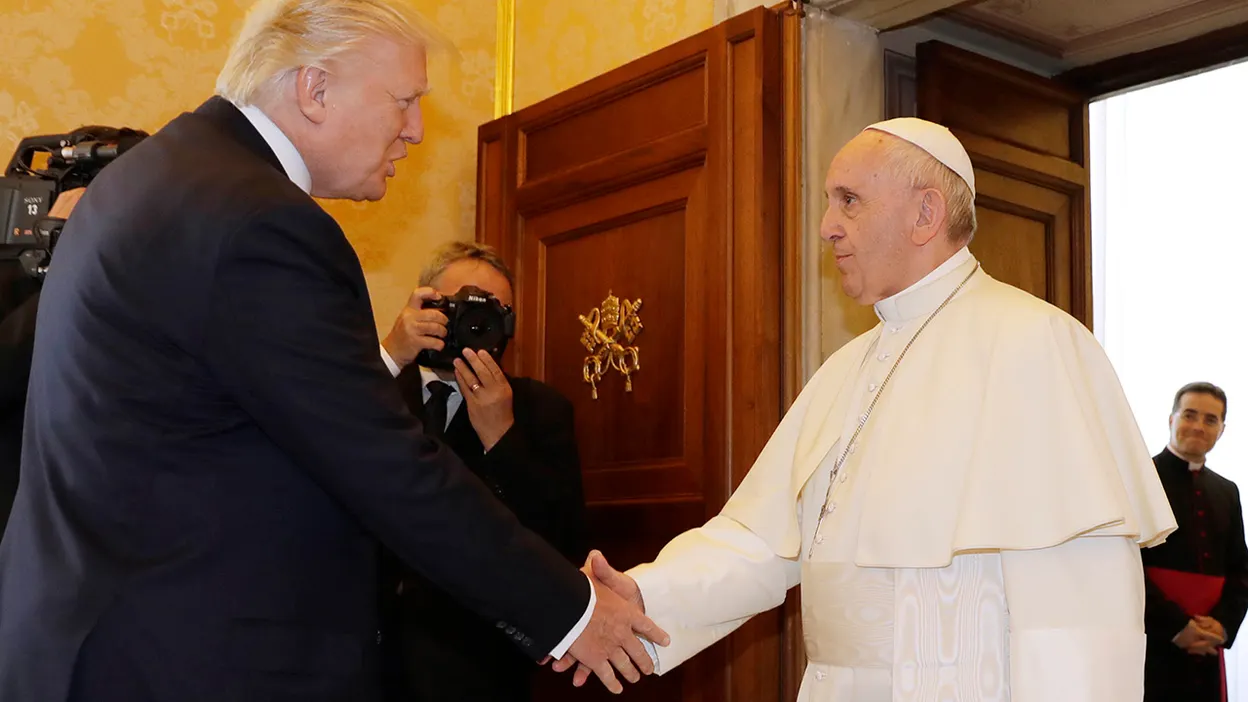
President Donald Trump ordered American flags to be flown at half-staff Monday following the death of Pope Francis.
The declaration comes after Trump wrote on Truth Social: “Rest in Peace, Pope Francis! May God bless him and all who loved him!”
“I just signed an executive order putting the flags of our country, all of them, all federal flags and state flags at half mast in honor of Pope Francis,” Trump said Monday. “He was a good man, worked hard. He loved the world. And it’s an honor to do that.”
The White House released a proclamation from Trump stating: “As a mark of respect for the memory of His Holiness Pope Francis, by the authority vested in me as President of the United States by the Constitution and the laws of the United States of America, I hereby order that the flag of the United States shall be flown at half-staff at the White House and upon all public buildings and grounds, at all military posts and naval stations, and on all naval vessels of the Federal Government in the District of Columbia and throughout the United States and its Territories and possessions until sunset on the day of interment.
“I also direct that the flag shall be flown at half-staff for the same length of time at all United States embassies, legations, consular offices, and other facilities abroad, including all military facilities and naval vessels and stations,” Trump added.
Trump, appearing Monday at the White House’s annual Easter Egg Roll event, also said “Easter is special.
“And it’s one of our favorite days. It’s one of our favorite periods of time. We’re honoring Jesus Christ. And, we’re going to honor Jesus Christ very powerfully throughout our lives, all throughout our lives. Not just now, all throughout our lives,” Trump said. “We’re bringing religion back in America. We’re bringing a lot of things back. But religion is coming back to America. That’s why you see the kind of numbers that you are seeing, the spirit and the kind of numbers that you’re seeing.”
Cardinals appointed by Pope Francis represent two-thirds of papal electors
Around two-thirds of the number of cardinals currently eligible to vote in a conclave were appointed by Pope Francis, a report said.
Francis appointed 81 men who are still under the age of 80, the LaCroix International newspaper reported in June 2023.
It added that those cardinals will become part of a 121-member group who are eligible to choose the next pope in a conclave.
Upon the death of a pope, the camerlengo of the Holy Catholic Church is the first to be notified.
The named camerlengo runs the Vatican in case of a pope’s death or resignation until a new one is elected.
When a pope is anticipated dead, the camerlengo formally determines the pope’s passing by calling out his baptismal name three times. If there is no response, the pope is pronounced dead.
Cardinal Kevin Joseph Farrell is the present camerlengo. He was appointed by Pope Francis in 2019.
During this time, the pope’s ring and bulla, a lead seal, are destroyed in the presence of other cardinals as a symbol that his reign has ended and to prevent misuse of his signature on formal documents. Additionally, the pope’s papal apartments are locked to forbid looting and the protection of his will.
Word that the pope has passed moves through official channels to notify the College of Cardinals, the vicar of Rome, Cardinal Baldassare Reina, and then the public.
Bishop Robert Barron, a widely read Catholic commentator and author, paid tribute to Pope Francis for a papacy marked by “mercy and evangelization” after the news of his death on Monday.
Barron, who leads the Diocese of Winona-Rochester in Minnesota and is the founder of the popular Catholic ministerial organization Word on Fire, praised Francis for recognizing the “destructiveness of sin.”
“Our Holy Father, Pope Francis, born Jorge Mario Bergoglio on December 17, 1936, has reached the end of his earthly pilgrimage,” Bishop Barron wrote in a statement shared with Fox News Digital. “Pope Francis was a great pastor who spoke from the heart and with tender affection.”
“I had the pleasure of meeting with Pope Francis several times during his papacy,” Bishop Barron continued. “On the occasions when he and I spoke, his comments would burn their way into my heart and mind. During a meeting with my fellow bishops, he reminded us that ‘the first task of a bishop is to pray.’”
“Pope Francis’ papacy was marked by two master themes: mercy and evangelization,” Barron wrote. “In an interview, he famously remarked that the Church is a field hospital to those wounded by our postmodern, relativistic society. It must, first and foremost, heal the wounds. Pope Francis had a keen awareness of the destructiveness of sin, and he encouraged the Church to show the world the merciful face of Christ. He also emphasized the importance of our personal witness to the light of faith, drawing others to the life-giving joy of the Gospel.”
The tradition of adopting a new name became common practice for newly-elected leaders of the Catholic Church by the eleventh century.
Roman pontiff “Mercurius” was the first pope to adopt a new name after ascending to his position in 533 AD. Feeling that he would “dishonor” his office with his pagan name, Mercurius became Pope John II, according to St. Catherine of Siena Roman Catholic Church.
Newly-chosen pontiffs may select their names for a variety of reasons. Some popes, including John II, chose names that honor a martyred predecessor. Others, like Pope Francis, selected names that signal their plans for the papacy. When selected for the role in 2013, Pope Francis told followers that he intended to emulate St. Francis of Assisi, “the man of the poor. The man of peace. The man who loved and cared for creation.”
In 1099, Pope Sergius IV, born Peter, chose his name out of respect for the first pope of the Catholic Church, St. Peter. No subsequent pope has named himself Peter.