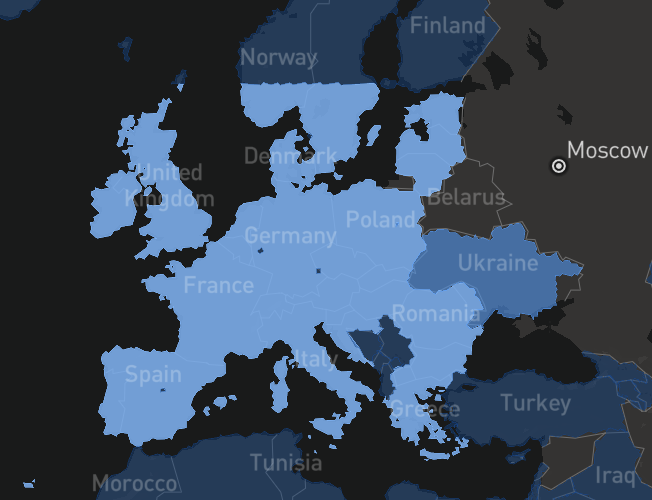
Starlink—the satellite internet service operated by SpaceX—has already covered much of Europe, but Serbia, Montenegro, and Bosnia and Herzegovina (BiH) are still waiting for its rollout . According to Starlink’s official coverage map, the service is planned for Serbia and Montenegro in 2025, while BiH still does not have a specified start date . Below, the regulatory, political, and commercial reasons for this delay are detailed, as well as the latest information (2024–2025) and statements from relevant parties, presented by country.
Serbia
- Regulatory obstacles: Starlink officially expressed interest in Serbia as early as 2021, when its local subsidiary (Starlink d.o.o. Beograd) applied to the national telecommunications regulator (RATEL) for service approval . However, the process was delayed because SpaceX did not initially submit the complete documentation required under Serbian law for registering a public communications network operator . RATEL confirmed it had been in constant communication with Starlink since 2021 and stated that the operator must meet all legally prescribed conditions before starting operations . After nearly three years, progress was finally made: as of mid-2024, RATEL still noted incomplete documentation, but by late 2024 reported that the licensing process was in its final stage . In other words, legal-bureaucratic formalities were the main cause of delay, but their completion now appears imminent.
- Political context: In Serbia’s case, no political opposition to the introduction of Starlink has been reported. Regulators and government officials have not expressed resistance—on the contrary, RATEL has worked with SpaceX and is ready to approve the service once conditions are met . Unlike in some countries where political bans are imposed on foreign satellite networks, Serbia has not set such barriers. The delay here is administrative, not politically motivated.
- Commercial considerations: Serbia has a relatively high level of internet penetration (over 84% of the population uses the internet) and strong terrestrial internet offerings in urban areas . As a result, Starlink is primarily appealing for rural and underserved areas (e.g., mountainous regions like Stara Planina) and specific user groups (campers, ships, remote farms) . The limited size of that market segment may have influenced Serbia not being included in the initial launch phases. Nevertheless, interest from users is present—Starlink already allows pre-orders in Serbia for a $9 deposit and has stated that availability depends on regulatory approval . This indicates that SpaceX is commercially ready to enter the market as soon as it receives the green light.
- Plans and recent statements: Starlink initially announced a launch in Serbia during 2024, but due to the above delays, the timeline has been adjusted. The latest coverage map shows 2025 as the start date . RATEL has confirmed that Starlink can begin operations as soon as all legal requirements are met, without further obstacles . In late December 2024, SpaceX CEO Elon Musk stated that Starlink had been activated in Kosovo and hinted that “the entire territory of Serbia and Montenegro will receive this technology in 2025” . All of this points to imminent commercial availability of Starlink service in Serbia during 2025.
Montenegro
- Regulatory obstacles: The Montenegrin Agency for Electronic Communications and Postal Services (EKIP) announced that since September 2023, it had been in contact with Starlink regarding the launch of services in Montenegro . EKIP provided SpaceX with all the necessary information about technical and regulatory conditions—including the fact that Starlink user terminals (dishes) do not require a separate frequency license (falling under general authorization) but that the company must establish a local subsidiary and register as an ISP in Montenegro . Unlike in Serbia, there were no delays due to additional permits—only the registration process remained. As of October 2024, no formal application had been submitted by Starlink or a related company to be listed in the operators’ registry . EKIP emphasized that the registration process takes a maximum of 7 days once a proper application is submitted and that a 2024 launch was entirely feasible if Starlink acted promptly . In other words, Montenegro faced minimal regulatory obstacles—everything boiled down to SpaceX completing the formal registration process.
- Political context: In Montenegro, there have been no indications of political hindrances to Starlink’s arrival. State authorities are open to new technologies, and EKIP has been cooperative and proactive in communicating with SpaceX . As a NATO member and EU candidate, Montenegro’s adoption of Starlink aligns with its pro-Western technological orientation. The government has not imposed any political conditions—on the contrary, the regulator prepared the ground for a quick launch as soon as the company was ready. This indicates that politics did not delay the process; the hold-up was due to SpaceX’s internal business decisions on when to launch the service.
- Commercial considerations: Montenegro is a small market (approximately 620,000 people) with most of the population concentrated in a few cities that already have decent internet infrastructure. Starlink’s primary potential lies in rural and hard-to-reach areas—for example, mountain villages in the north and scattered rural households currently lacking good broadband. These users exist but represent a limited segment, possibly explaining why Montenegro wasn’t included in the first wave of Starlink expansion. At the same time, its geographic characteristics (mountains, dispersed settlements) mean there’s a real need for satellite internet to bridge the digital divide in remote communities . Starlink would enhance competition and complement existing infrastructure, although commercial success will depend on pricing that matches Montenegrins’ purchasing power (which SpaceX usually adjusts per country). For now, SpaceX seems to have decided that Montenegro can wait until larger markets are covered, though there’s definite interest in this niche.
- Plans and recent statements: According to Starlink’s map, service in Montenegro is officially slated to start in 2025 (after more than a year of announcements) . EKIP noted in 2024 that a launch was possible as soon as an application arrived, suggesting no obstacles from their side . In December 2024, following Musk’s Kosovo announcement, regional media reported that Montenegro (and Serbia) should receive Starlink in 2025 . As of April 2025, the service is still not active, but there are no indications of further delays—SpaceX is expected to finalize administrative steps and begin Starlink operations in Montenegro by the end of 2025, bringing coverage to the region on par with neighboring countries.
Bosnia and Herzegovina
- Regulatory obstacles: In Bosnia and Herzegovina, Starlink has yet to start the formal process of obtaining licenses. The company expressed interest in entering the BiH market as of September 2024, but the Communications Regulatory Agency (RAK) stated that SpaceX has not filed an application for the necessary permits to proceed . This means Starlink is not yet legally authorized to operate in the country. It’s not clear what’s causing the delay in submitting the application—SpaceX may be waiting until neighboring countries’ rollouts are complete or gathering required documentation. Based on experiences in Serbia and Montenegro, it’s likely that BiH will also require SpaceX to establish a local subsidiary and register with RAK, but as of early 2025, that process has not even started.
- Political context: While BiH lags in introducing Starlink, there are no signs that politics are the reason. Unlike some global instances where governments block satellite internet, there have been no such decisions in BiH—Starlink simply hasn’t applied yet. That said, BiH’s political environment is complex (multiple levels of government and regulatory authority), which may slow down innovation. It’s possible that BiH lacks a strong institutional advocate for Starlink, so the matter hasn’t been prioritized yet. On the other hand, officials acknowledge the importance of technology: the prospect of BiH remaining the only country in the region without Starlink has raised public concern . This indirectly pressures decision-makers to facilitate Starlink’s arrival. In short, politics aren’t blocking Starlink in BiH, but they aren’t speeding it up either—inertia and focus on other issues might be a factor in the slow progress.
- Commercial considerations: Like Montenegro, BiH is a relatively small market with limited purchasing power. The cost of Starlink service in Europe is about $90 per month (plus roughly $500 for equipment), which is a significant expense for the average BiH household . This means the commercial potential for profitability may be lower, causing SpaceX to delay its rollout. However, due to less-developed internet infrastructure (around 79% of BiH’s population uses the internet, lower than neighboring countries), there’s a larger gap that Starlink can fill . Rural areas and mountainous regions of BiH suffer from poor connectivity, so satellite internet has a key role in digitally including these communities. Commercially, Starlink will likely adjust prices to local conditions and target enthusiasts, remote households, businesses without good internet access, and public services that would benefit (civil protection, emergency communications, etc.). In short, although BiH was not a priority for initial launches due to its smaller market, there is a real need for the service, and its viability will depend on how many customers can be attracted at an affordable price.
- Plans and recent statements: BiH still does not have a clear timeline. On the Starlink website, BiH is marked as a region where the “start date is currently unknown” . In other words, SpaceX has not publicly set a date for launching Starlink in BiH. It is expected that service will arrive after Serbia and Montenegro, making BiH the last in the region to gain Starlink coverage . This is further confirmed by the fact that Croatia (2021), North Macedonia (2022), Albania (2024), and Kosovo (2024) have already received Starlink , leaving BiH as the exception. RAK representatives have not provided any concrete dates or statuses, other than inviting SpaceX to formally apply. Given the expressed interest and Starlink’s expansion in neighboring areas, it’s reasonable to expect that SpaceX will eventually launch in BiH—likely after 2025—once it clears any remaining bureaucratic hurdles and deems it commercially viable. Until then, BiH will continue observing its neighbors’ experiences and preparing the regulatory environment so that Starlink can be implemented more quickly once the company decides to enter this market.
Sources: SpaceX/Starlink official documentation and maps; statements from regulatory agencies (RATEL, EKIP, RAK) in the media; reports from N1, Bloomberg Adria, Sarajevo Times, TRT Balkan, and others (2023–2025) .